

By Folarin Jamiu
In the event of elections around the world in 2020 and challenges posed by political dis and misinformation, stakeholders have raised concerns about the implication of this period for the political process. Multiple approaches have been adopted by stakeholders to address these challenges in the digital public space that is seen as a catalyst to the spread of false information and political propaganda. Facebook is one of the tech companies that provide platforms for dissemination of political messages and has sustained collaboration with fact-checking organisations to flag and label contents on Facebook platforms as a way of bringing sanity to the digital public sphere. Following concerns raised by stakeholders about the negative use of Facebook by politicians on one hand, and of the need, on the other hand, to promote principles of “free marketplace of ideas,” Facebook has been changing its policy to satisfy the two opposing demands. This study therefore undertook an assessment of Facebook policy on fact-checking politicians and reflected on whether this policy has influence on the editorial contents of fact-checking organisations in Nigeria (Africa Check, Dubawa and AFP Hub) which are all signatories to the International Fact-Checking Network (IFCN).
The study reviewed the Facebook policies of fact-checking politicians in relation to literature on the same subject and reference to two of the five IFCN principles related to the policy. Assuming that it is the responsibility of the media to make the government accountable as enshrined in the constitution, the study sought to understand the influence of Facebook policy on fact-checking politicians on the editorials of fact-checking organisations in Nigeria? One of the questions that arose from the assessment of Facebook policy is whether fact-checking claims of politicians and political ads amount to “censoring or stifling political discourse”? While reflecting on the above concerns of stakeholders, the study concluded that Facebook finds itself in an ethical dilemma. It also submitted that in view of the available evidence, the Facebook policy on fact-checking politicians has no noticeable influence on the editorial contents of the fact-checking organisations, despite Facebook funding of some fact-checking organisations in Nigeria. The two IFCN principles that serve as yardstick to reach this conclusion are: “Commitment to Non-partisanship and Fairness” and “Commitment to Transparency of Funding and Organisation.”
The study also observed and recommended as follows:
- The changes in Facebook policy on fact-checking political claims and ads on its platform was an attempt to maintain a balance between entrenching free speech and bringing sanity to the digital public space often weaponised for political gains.
- That the exceptions given to politicians and political ads in respect of fact-checking could be termed discriminatory, as similar opportunity is not available to other users of Facebook. Without prejudice to the ethical decision adopted by Facebook, it is instructive to have a general policy that will be binding on all users of Facebook, irrespective of their political, religious, economic, and social status.
- There is also a need for international discourse on the challenges occasioned by the ethical dilemma of Facebook and information disorder in the world. The United Nations and IFCN have a role to play to provide the leadership for this engagement. The call for a UN charter on political disinformation and other variants of information pollution is not out of place. This Charter, if enacted, is expected to put to rest the debate over desirability for legal framework or voluntary intervention to address the challenge of dis and misinformation especially on the digital public space.
- This is the time that Facebook and other tech companies need to invest more on Media, especially Information and Digital Literacy, to empower social media users to develop defence mechanisms against all forms of disinformation on their platforms.
- In addition, the IFCN should sustain its efforts at ensuring that fact-checking organisations across the world are guided by its five code of principles in order to continue to sustain integrity in the fact-checking landscape.
- There is a need to further investigate the severity of political dis and misinformation on the political process and measure the extent to which the interventions of the tech companies have reduced the negative effect of information disorder in the political system.
- Further studies should also explore content analysis of political ads on Facebook and other social media platforms to understand the severity of political disinformation on these platforms.
[Read full study here]
FACT CHECKS OF THE WEEK
The #EndSARS protest demanding an end to police brutality lasted for two weeks and was peaceful until it was hijacked by hoodlums who burnt police…

Nigeria’s former Aviation Minister, Femi Fani-Kayode, on his Twitter handle, @realFFK, recently made some bogus statements. The politician asked if people know…

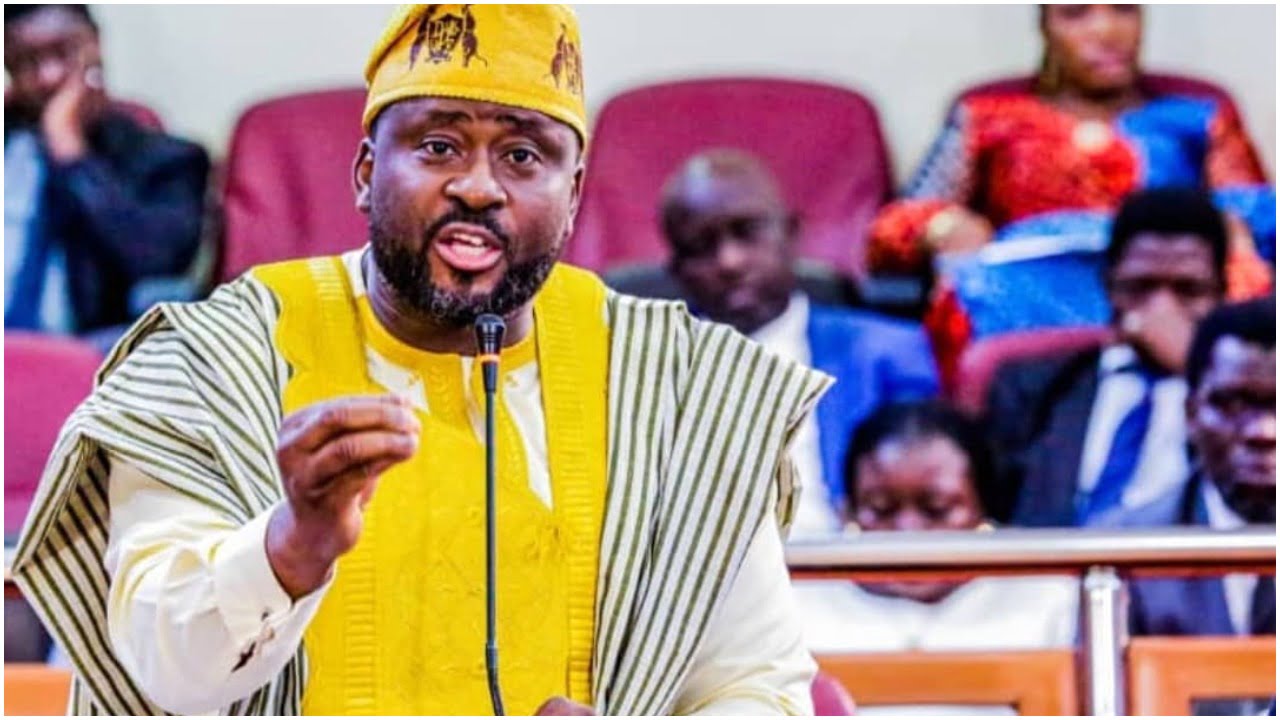
Several news websites including ThewillNigeria, Naijadiary reported that Desmond Elliot called for the regulation of social media in Nigeria following the #EndSARS protest. Is this true?
QandA
- Are 63% of young Nigerians jobless or underemployed as claimed recently?
The claim that 63 percent of Nigerians under 30 are either jobless or underemployed is partly true. Nigeria’s Labour Force Statistics for the second quarter of 2020 shows that 34.9 percent of Nigerians aged 15 to 34 years are jobless while 28.2 percent of Nigerians within the same age bracket are underemployed. This means that 63.1 percent of Nigerians within the same age bracket are either jobless or underemployed. However, not all of them are under 30. (Read more here.)
What can you do?
Be alert, share our tips and don’t share false news!
Coronavirus infection count
Note: Total cases may be more than officially stated owing to the inability to include unconfirmed cases. Stay safe
Tip of the week
#FakeNews Alert
- “Hot pineapple ~ can kill cancer cells.” – SOURCE: WhatsApp Message
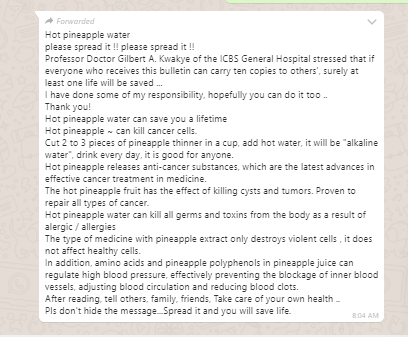
The image presented above is a screenshot of a WhatsApp Message. The message inferred that hot pineapple water can cure cancer due to certain anticancer substances present in the water. Also, while stating steps in preparing the cure, it advised on usage. Finally, as a common practice with WhatsApp Broadcast Messages, it appeals to readers to share the information further.
Information of this sort needs to be approached with a huge dose of scepticism.
Why? Over time, WhatsApp broadcast messages have been consistent with spreading misinformation while appealing to readers’ emotions and shielding their weaknesses with false attributions. To this end, it is highly important to ascertain the veracity of this post by consulting multiple credible sources before sharing further.
Other Fact-checks/Articles
- No, This is not a Picture of #EndSARS Protesters
- No, These Are Not Katsina Women Calling Buhari to Resign
- Explainer: How veto power works in WTO decision making
- Facebook Fact-Checking Policy Framework and Nigerian Politicians: A Critical Reflection
- Viral post on FG giving out grants to support Nigerians is a hoax